Summary

Introduction

Context

Effective policymaking relies heavily on monitoring, as assessing the impact of legislation and policies is crucial to determining whether specific objectives have been met. However, lack of coordination when setting reporting requirements can lead to legal interoperability barriers that then lead to inefficient policy measures, and to duplicated and overlapping requirements, data duplication, and unclear data location.

To address this challenge, the European Commission announced in its Communication on the Long-term competitiveness of the EU (16 March 2023) that it would "make a fresh push to rationalise and simplify reporting requirements for companies and administrations." The Commission aims to introduce initial proposals for the green, digital, and economic thematic areas by autumn 2024, with the goal of reducing administrative burdens by 25% without compromising related policy objectives.

In support of this initiative, the European Commission has identified streamlining regulatory reporting as a key area for reducing administrative burden. By providing policy officers with a detailed understanding of existing legal frameworks and enabling them to leverage these frameworks, the Commission seeks to eliminate redundancies and harmonise reporting requirements, ultimately reducing the complexity and burden associated with regulatory reporting.

Potential uses of the model

Status

This application profile has the status SEMIC Recommendation published on 2025-10-01.

Information about the process and the decisions involved in the creation of this specification are consultable at the Changelog.

License

Copyright © 2025 European Union. All material in this repository is published under the license Creative Commons Attribution 4.0 International (CC BY 4.0), unless explicitly otherwise mentioned.

This data specification has not yet formalized any conformance requirements besides the proper use of the terms according to the formal specification in the sections Main Entities and Supporting Entities.

Terminology

An Application Profile is a specification that reuses terms from one or more base standards, adding more specificity by identifying mandatory, recommended and optional elements to be used for a particular application, as well as recommendations for controlled vocabularies to be used.

An Annex to an Application Profile is a specification that clarifies the use of some aspects of the Application Profile for a specific context.

This specification uses the following prefixes to shorten the URIs for readability.
PrefixNamespace IRI
dcthttp://purl.org/dc/terms/
elihttp://data.europa.eu/eli/ontology#
rdfhttp://www.w3.org/1999/02/22-rdf-syntax-ns#
rdfshttp://www.w3.org/2000/01/rdf-schema#
rrmvhttp://data.europa.eu/2qy/rrmv#
skoshttp://www.w3.org/2004/02/skos/core#
timehttp://www.w3.org/2006/time#
xsdhttp://www.w3.org/2001/XMLSchema#

Overview

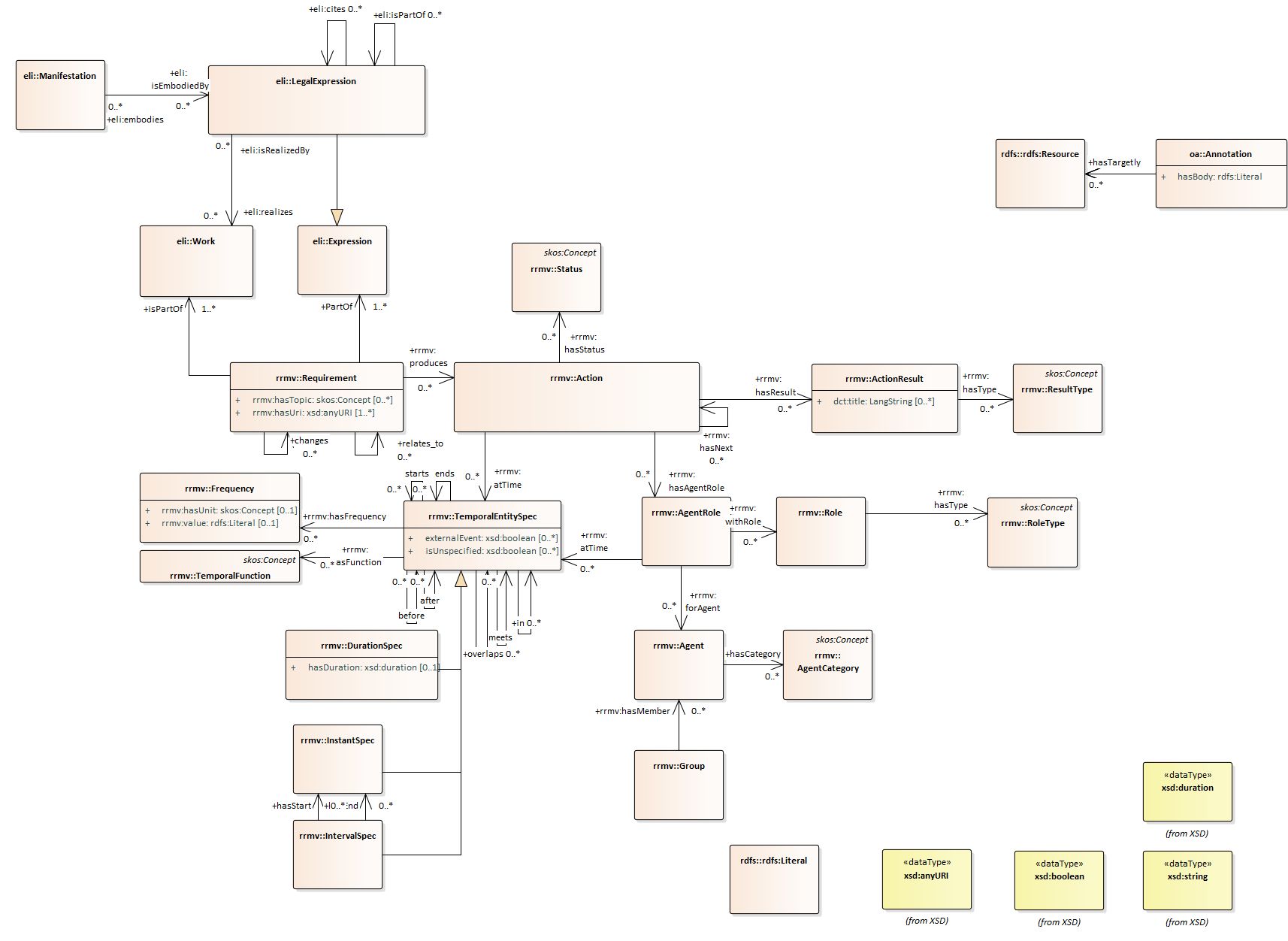
An overview of RRMV is shown in the UML diagram below. The UML diagram illustrates the specification described in this document. For readability purposes the representation has been condensed as follows:

The cardinalities and qualifications are included in the figure.

This document describes the usage of the following main entities for a correct usage of the Application Profile:
| Action | Action Result | Agent | Agent Role | Requirement | Temporal Entity Specification |

The main entities are supported by:
| Agent Category | Annotation | Concept | Duration Temporal Entity Specification | Expression | Frequency | Group | Instant Temporal Entity Specification | Interval Temporal Entity Specification | Legal Expression | Literal | Manifestation | Resource | Result Type | Role | Role Type | Status | Temporal Function | Work |

And supported by these data types:
| langString | xsd:anyURI | xsd:boolean | xsd:duration | xsd:string |

Main Entities

The main entities are those that form the core of the Application Profile. The properties and their associated constraints that apply in the context of this profile are listed in a tabular form. Each row corresponds to one property.

As this is the toplevel application profile for this usage context the reuse of the terms is indicated by their URIs. If an URI is used from another vocabulary than the namespace 2qy it means that the information is inherited as expressed in the data specification in which that URI is defined.

Action

Definition
An event with at least one agent that is participant in it in a given time.
Properties
For this entity the following properties are defined: at time , has agent role , has next , has result , has status .
Property Range Card Definition Usage
at time Temporal Entity Specification 0..* An action or an agent role is at a specific time if it occurs, is valid, or is relevant at that particular point in time or during a specific time period.
has agent role Agent Role 0..* The involvement of an agent in a role within this action. The involvement of the agent may be time dependent.
has next Action 0..* A succeeding action A requirement may formulate a repetitive sequence of actions. This property chains the actions together.
has result Action Result 0..* A result of this action.
has status Status 0..* A status of this Action.

Action Result

Definition
The outcome of an Action.
Usage Note
It could be an activity (e.g., to do something) or a physical or digital entity (e.g., report).
Properties
For this entity the following properties are defined: has title , has type .
Property Range Card Definition Usage
has title langString 0..* The title of the ActionResult.
has type Result Type 0..* A kind of result

Agent

Definition
A legal subject, which refers to any entity involved in an Action, including but not limited to individual entities (such as natural persons or organizations) and groups of entities (such as classes of persons, organizations, or things)
Properties
For this entity the following properties are defined: has category .
Property Range Card Definition Usage
has category Agent Category 0..* A property connecting the Agent to its AgentCategory.

Agent Role

Definition
A supportive class connecting agents with a role they play.
Properties
For this entity the following properties are defined: at time , for agent , with role .
Property Range Card Definition Usage
at time Temporal Entity Specification 0..* An Action or a Role is valid within a time interval.
for agent Agent 0..* The property linking a particular Role to Agent.
with role Role 0..* The property linking a Agent to Role

Requirement

Definition
A portion of legal source expression including a mandate that produces at least one Action.
Usage Note
A Requirement represents a normative provision within a legal text that mandates, permits, or prohibits specific actions. It typically corresponds to an article, paragraph, or clause that establishes obligations for identified agents. For example, Article 26(2) of Regulation (EU) 2018/1999 constitutes a reporting Requirement because it mandates Member States to submit greenhouse gas inventories to the Commission. Each Requirement is linked to the specific portion(s) of the legal text through has URI and must produce at least one Action representing the mandated activity.
Properties
For this entity the following properties are defined: changes , has topic , has URI , is part of , part of , produces , related to .
Property Range Card Definition Usage
changes Requirement 0..* Indicates that this requirement legally changes another. This encompasses the notions of amendment, replacement, repeal, or other types of change. This may be a direct change (textual or non-textual amendment) or a consequential or indirect change.
has topic Concept 0..* A requirement has a topic if the requirement is related to or pertains to a specific concept or subject matter.
has URI xsd:anyURI 1..* associates a rrmv:Requirement with a unique identifier, denoted by a Uniform Resource Identifier (URI), which serves as a reference to the portion (or portions) of the text from where the Requirement is expressed and modelled. Multiple values indicate that the union of the content of these URIs should be considered for the complete understanding of the Requirement. This property can be repeated, as different portions of the act may encode different aspects of the Requirement, for instance, the addressees may be in one article, while the temporal aspects may be in another.
is part of Work 1..* A related resource in which the described resource is physically or logically included.
part of Expression 1..* A Requirement is part of an Expression if the requirement is a component, provision, or clause of that Expression
produces Action 0..* The action that is produced by a requirement.
related to Requirement 0..* Indicates a somehow related other requirement.

Temporal Entity Specification

Definition
A temporal entity specification serving as an abstract class for all temporal specifications. It includes specifications for instants, intervals, frequency, and durations, functioning as the structure for expressing temporal constraints related to normative provisions and other use cases.
Properties
For this entity the following properties are defined: after , before , ends , external event , has frequency , has function , in , is unspecified , meets , overlaps , starts .
Property Range Card Definition Usage
after Temporal Entity Specification 0..* Indicates that one temporal entity specification occurs following another one.
before Temporal Entity Specification 0..* Indicates that one temporal entity specification precedes another one.
ends Temporal Entity Specification 0..* Establishes that one temporal entity specification marks the conclusion of another one.
external event xsd:boolean 0..* Indicates whether a temporal entity specification depends on events outside the regulatory framework's direct control. Set to true when the temporal specification depends on events outside the regulatory framework's direct control (e.g., 'within 30 days of the disaster declaration', 'upon completion of the national consultation'). Set to false for calendar-based deadlines.
has frequency Frequency 0..* The frequency in which the Action is to be executed in case of repetitive mandate.
has function Temporal Function 0..* The function played by the TemporalEntitySpecification, such as a deadline or a validity period. For instance as deadline, moment of entering into force, etc.
in Temporal Entity Specification 0..* Establishes that one temporal entity specification occurs entirely within the boundaries of another temporal entity specification.
is unspecified xsd:boolean 0..* Indicates whether a temporal aspect exists but is undefined or it depends on an event external to the legislative corpus. Set to true when the legal text indicates that a temporal aspect exists but does not specify its exact value (e.g., 'as soon as possible', 'in due time'). This differs from external event which refers to temporally defined but externally triggered events.
meets Temporal Entity Specification 0..* Indicates that one temporal entity specification directly adjoins another one without overlap, where one ends exactly when the other begins.
overlaps Temporal Entity Specification 0..* Indicates that two temporal entities specifications share a common portion of time without either completely containing the other.
starts Temporal Entity Specification 0..* Establishes that one temporal entity specification marks the beginning of another one.

Supporting Entities

Supporting entities complement the main entities in the Application Profile. The scope and objectives of the profile are fully covered by the main entities; supporting entities serve as property ranges or as subclasses used in specific use cases. In this context, supporting entities are those defined in the same namespace as the main entities; imported entities are listed in a subsequent section.

Agent Category

Definition
The category of Agent.
Subclass of
Concept
Properties
This specification does not impose any additional requirements to properties for this entity.

Duration Temporal Entity Specification

Definition
A continuous amount of time without reference to specific temporal points. It defines a time interval in terms of length rather than absolute positioning in time, used to express concepts such as 'within 30 days', 'for 6 months', or other relative temporal requirements that are not anchored to calendar dates.
Subclass of
Temporal Entity Specification
Properties
For this entity the following properties are defined: has duration .
Property Range Card Definition Usage
has duration xsd:duration 0..1 Links a duration specification to its duration value, quantifying the time periods

Frequency

Definition
The rate at which a temporal entity recurs or repeats over a specified period of time.
Usage Note
Specify both the numeric value and the unit to define how often an action recurs (e.g., value='1' with unit='Quarter' means 'once per quarter').
Properties
For this entity the following properties are defined: has unit , value .
Property Range Card Definition Usage
has unit Concept 0..1 The unit of the Frequency e.g. Quarter
value Literal 0..1 The value of the frequency.

Group

Definition
Legal subjects involved in an Action that constitutes a group of entities, such as classes of persons, organisations or things
Properties
For this entity the following properties are defined: has member .
Property Range Card Definition Usage
has member Agent 0..* A Group has a member if the Agent is part of the Group, either as an individual entity or as a subgroup.

Instant Temporal Entity Specification

Definition
A set point in time, representing a single moment without duration. It can be used, for example, when a normative provision establishes a specific temporal reference, such as a deadline, start time, or activation moment. This class is appropriate for establishing unique temporal reference points for normative provisions and other use cases.
Usage Note
Use this class for specific points in time such as '31 July 2021', 'the date of entry into force', or 'the moment of notification'. Unlike intervals, instants have no duration.
Subclass of
Temporal Entity Specification
Properties
This specification does not impose any additional requirements to properties for this entity.

Interval Temporal Entity Specification

Definition
A segment of time with determined start and end points, representing a period of time. This class is appropriate for modelling validity periods, time windows for regulatory compliance, and reporting cycles with defined temporal boundaries, among others.
Usage Note
While multiple start or end points are technically possible, typically an interval has one start and one end instant. Multiple values may be used to express alternative or conditional boundaries.
Subclass of
Temporal Entity Specification
Properties
For this entity the following properties are defined: has end , has start .
Property Range Card Definition Usage
has end Instant Temporal Entity Specification 0..* Connects an interval to its concluding instant.
has start Instant Temporal Entity Specification 0..* Connects an interval to its starting instant.

Result Type

Definition
The kind of Action Result
Usage Note
Associates entities with their class in a controlled vocabulary.
Subclass of
Concept
Properties
This specification does not impose any additional requirements to properties for this entity.

Role

Definition
The function played by an Agent involved in an Action.
Properties
For this entity the following properties are defined: has type .
Property Range Card Definition Usage
has type Role Type 0..* A kind of Role

Role Type

Definition
The kind of Role played by an Agent.
Subclass of
Concept
Properties
This specification does not impose any additional requirements to properties for this entity.

Status

Definition
The legal status of an Action.
Subclass of
Concept
Properties
This specification does not impose any additional requirements to properties for this entity.

Temporal Function

Definition
A specific temporal role or function. It classifies temporal specifications according to their functional meaning in the normative provisions, such as "deadline", "validity period", or "reporting frequency". This classification helps to interpret the meaning of various temporal specifications within the regulatory framework, among others.
Usage Note
for instance as deadline, moment of entering into force, etc.
Subclass of
Concept
Properties
This specification does not impose any additional requirements to properties for this entity.

Imported Supporting Entities

The supporting entities are supporting the main entities in the Application Profile. The scope and objectives of the Application profile is fully covered with the main entities. The listed entities are supporting because they form the range of properties or are detailed subclasses exploring specific aspects of some use cases. In this application profile, the supporting imported entities are those that are defined in a different namespace from the main entities.

Annotation

Definition
The class for Web Annotations.
Properties
For this entity the following properties are defined: body value , has body , has target .
Property Range Card Definition Usage
body value Literal 0..* A plain text string to be used as the content of the body of the Annotation.
has body Resource 0..* The object of the relationship is a resource that is a body of the Annotation.
has target Resource 0..* The relationship between an Annotation and its Target.

Concept

Definition
An idea or notion; a unit of thought.
Usage Note
However, what constitutes a unit of thought is subjective, and this definition is meant to be suggestive, rather than restrictive.
Properties
For this entity the following properties are defined: preferred label .
Property Range Card Definition Usage
preferred label Literal 1..n A preferred label of the concept. This property can be repeated for parallel language versions of the label.

Expression

Definition
The intellectual realisation of a Work in the form of identifiable immaterial objects, such as, but not limited to, text. The substance of Expression is signs. An Expression cannot exist without a physical carrier but do not depend on a specific physical carrier and can exist on one or more carriers simultaneously.
Properties
This specification does not impose any additional requirements to properties for this entity.

Legal Expression

Definition
The intellectual realisation of a legal resource in the form of a "sequence of signs" (typically alpha-numeric characters in a legal context). For example, any version of the legal resource whose content is specified and different from others for any reason: language, versions, etc.; Note that ELI ontology accommodates different point of view on what should be considered a new legal resource, or a new legal expression of the same resource. Typically, a consolidated version can be viewed, in the context of ELI, either as separate legal resource (linked to original version and previous consolidated version using corresponding ELI relations), or as a different legal expression of the same legal resource.
Subclass of
Expression
Properties
For this entity the following properties are defined: cites , embodies , is part of , realizes .
Property Range Card Definition Usage
cites Legal Expression 0..* Citation in the text of the legislation. This may be at the legal resource or legal expression level, as required by the implementation context. This includes verbatim citation and citations in referrals.
embodies Manifestation 0..* Relates a manifestation to the expression that it embodies. Inverse of "is_embodied_by".
is part of Legal Expression 0..* Indicates a work in which this one is physically included. Covers the case of text included in an Official Journal, or an article included in a text.
realizes Work 0..* Relates an expression to a work realised through that expression. Inverse of "is_realized_by".

Literal

Definition
A literal value such as a string or integer; Literals may be typed, e.g. as a date according to xsd:date. Literals that contain human-readable text have an optional language tag as defined by BCP 4715.
Properties
This specification does not impose any additional requirements to properties for this entity.

Manifestation

Definition
The physical embodiment of an Expression, either on paper or in any electronic format.
Properties
For this entity the following properties are defined: is embodied by .
Property Range Card Definition Usage
is embodied by Legal Expression 0..* Relates an expression to a manifestation of that expression.

Resource

Definition
Anything described by RDF.
Properties
This specification does not impose any additional requirements to properties for this entity.

Work

Definition
Any distinct intellectual creation (i.e., the intellectual content), in the context of ELI.
Properties
For this entity the following properties are defined: is realized by .
Property Range Card Definition Usage
is realized by Legal Expression 0..* Relates a work to an expression of this work in the form of a "sequence of signs" (typically alpha-numeric characters in a legal context).

Data Types

The following data types are used within this specification.
Class Definition
The datatype of language-tagged string values.
An anyURI represents an Internationalized Resource Identifier Reference (IRI).
A boolean represents the values of two-valued logic.
duration represents a duration of time. The value space of duration is a six-dimensional space where the coordinates designate the Gregorian year, month, day, hour, minute, and second components defined in § 5.5.3.2 of [ISO 8601], respectively.
The string datatype represents character strings in XML.

OWL Representation

The authoritative representation of the ontology is the OWL file downloadable at the EU Vocabularies Portal. The OWL file also includes the initial version of the SKOS [[skos-reference]] concepts list, which can be used to further extend and complement the ontology.

Controlled Vocabularies

The usage of controlled vocabularies in RRMV conforms to the best practices set by the Publications Office. In the context of this specification, classes mapped on the URI skos:Concept always indicate the usage of some controlled vocabulary.

In addition, the following controlled vocabularies MUST be used for the properties listed below. In this document, "MUST be used” means that the value space of the property is closed to terms from the specified controlled vocabulary; validation systems SHOULD report errors when values fall outside that space.

The controlled vocabularies are under development. Currently they are distributed as part of the OWL representation [[[#owl-representation]]].

Property URIUsed for ClassCodes are instances of Class Usage note
rrmv:hasTypeAction ResultResult Type
rrmv:hasTypeRoleRole Type
rrmv:hasCategoryAgentAgent Category
rrmv:hasStatusActionStatus

Examples

The following examples illustrate the use of RRMV. They are fictitious and serve solely to clarify how to use the Application Profile.

Annotations

In this section we illustrate how the texts from legal documents are connected with the RRMV main classes. The objective of RRMV is to provide a structured representation for legal expressions that mandate an activity. Embedding and sharing the text from which the structure representation has been derived is in principle not needed because the one can retrieve this via the relationships that connect Requirement with the legal documents (isPartOf eli:Work, PartOf eli:Expression). Nevertheless, while these relationships are sufficient for the main use cases, it is often necessary to provide a finergrained reference to the text that initiated an instance. Such textual extracts aid trustbuilding and the editorial process when establishing RRMV instances.

The Web Annotation Vocabulary for the RRMV context

The RRMV utilises the Web Annotation Vocabulary [annotation-vocab] to establish connections between the classes of the ontology and the relevant portions of the legal text. In the context of the RRMV, the usage of this vocabulary has been restricted in the following ways: Additional functionalities of the Web Annotation Vocabulary are not considered essential for the RRMV and are therefore beyond its scope.

Example annotations

Running example context

To make the examples tangible and illustrate the use of the RRMV, we refer to Article 26 of Regulation (EU) 2018/1999 on the Governance of the Energy Union and Climate Action (please include the link to the legislative act), which reads as follows:
Regulation (EU) 2018/1999 of the European Parliament and of the Council of 11 December 2018 on the Governance of the Energy Union and Climate Action, amending Regulations (EC) No 663/2009 and (EC) No 715/2009 of the European Parliament and of the Council, Directives 94/22/EC, 98/70/EC, 2009/31/EC, 2009/73/EC, 2010/31/EU, 2012/27/EU and 2013/30/EU of the European Parliament and of the Council, Council Directives 2009/119/EC and (EU) 2015/652 and repealing Regulation (EU) No 525/2013 of the European Parliament and of the Council (Text with EEA relevance.)

This requirement establishes a recurring reporting action by Member States to submit to the Commission their approximated greenhouse gas inventories for year X1, with the first deadline on 31 July 2021 and subsequent deadlines on 31 July each year. The following subsections use this context to illustrate the use of RRMV.

Main entities example

For the running example the following core structure can be constructed according to RRMV. Using addition background knowledge, interpreting the temporal specification and the agent roles, enables to represent a specific activity by the agent France for the year 2023.

Temporal representation

This section focusses on the use of the temporal specifications to denote the temporal aspects of a Requirement. The RRMV temportal specifications provide a adaptable environment to express these temporal aspects. Here we illustrate typical patterns.
In the running example the requirement is about a reporting that hase to be performed each year. These are determined as a collection of deadlines 31 July 2021, 31 July 2022, 31 July 2023, ... with no end.
One possible representation is as follows expressing it as a instant with a frequency. An alternative representation is by expressing it a moment in a range of deadlines: an instance which is constrainted by a start date and a frequency. In the future this section will be elaborated with more examples.

Support for implementation

Implementing the RRMV data specification in a data exchange between two systems raises also technical questions.

JSON-LD context file

One common technical question is the format in which the data is being exchanged. For RRMV conformance, it is not mandatory that this happens in a RDF serialisation, but the exchanged format SHOULD be unambiguously be transformable into RDF. For the format JSON, a popular format to exchange data between systems, RRMV provides a JSON-LD context file. JSON-LD is a W3C Recommendation [[json-ld11]] that provided a standard approach to interpret JSON structures as RDF. The provided JSON-LD context file can be used by implementers to base their data exchange upon, and so create a RRMV conformant data exchange. This JSON-LD context is not normative, i.e. other JSON-LD contexts are allowed to create a a conformant RRMV data exchange.

The JSON-LD context file downloadable here.

Validation

To verify if the data exchange is (technically) conformant to RRMV, the exchanged data can be validated using the provided SHACL shapes. SHACL [[shacl]] is a W3C Recommendation to express constraints on a RDF knowledge graph. The provided SHACL shapes allow to check whether data expressed in a RDF serialization is valid. As it should be possible for RRMV conformance to transform the data exchange in RDF, these SHACL shapes can be used in any data exchange context. However, likewise the use of the JSON-LD context, the provided SHACL shapes provide only a start point for implementers.

The file rrmv-SHACL.ttl is the generated SHACL representation.

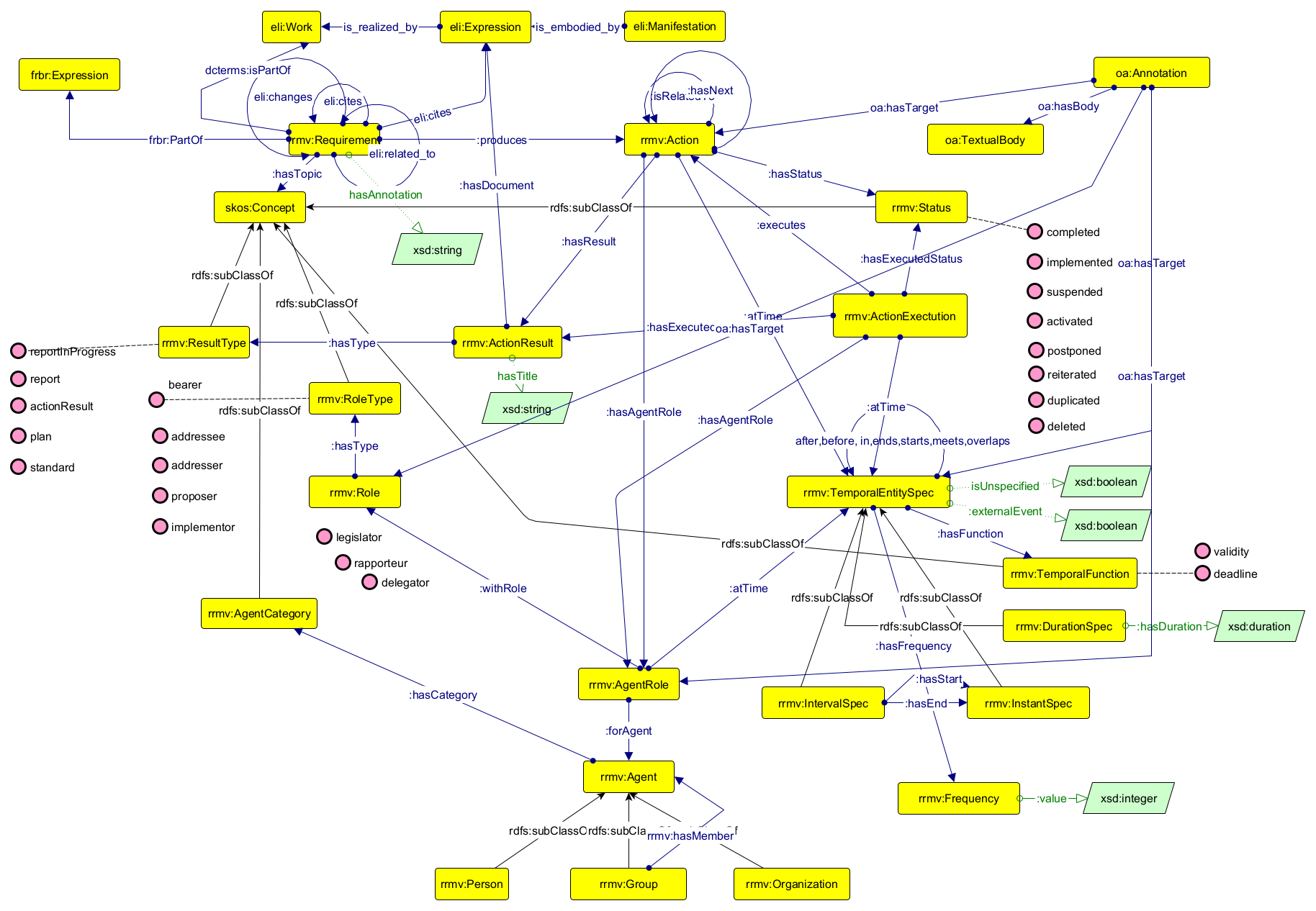
Alternative visualisation

To additionally illustrate the RRMV the following additional representation is provided.

Quick Reference of Classes and Properties

This section provides a condensed tabular overview of the mentioned classes and properties in this specification. The properties are grouped under headings mandatory, recommended, optional and deprecated. These terms have the following meaning.
ClassClass IRIProperty TypePropertyProperty IRI
Action
http://data.europa.eu/2qy/rrmv#Action
at time
http://data.europa.eu/2qy/rrmv#atTime
Action
http://data.europa.eu/2qy/rrmv#Action
has agent role
http://data.europa.eu/2qy/rrmv#hasAgentRole
Action
http://data.europa.eu/2qy/rrmv#Action
has next
http://data.europa.eu/2qy/rrmv#hasNext
Action
http://data.europa.eu/2qy/rrmv#Action
has result
http://data.europa.eu/2qy/rrmv#hasResult
Action
http://data.europa.eu/2qy/rrmv#Action
has status
http://data.europa.eu/2qy/rrmv#hasStatus
Action Result
http://data.europa.eu/2qy/rrmv#ActionResult
has title
http://purl.org/dc/terms/title
Action Result
http://data.europa.eu/2qy/rrmv#ActionResult
has type
http://data.europa.eu/2qy/rrmv#hasType
Agent
http://data.europa.eu/2qy/rrmv#Agent
has category
http://data.europa.eu/2qy/rrmv#hasCategory
Agent Category
http://data.europa.eu/2qy/rrmv#AgentCategory
Agent Role
http://data.europa.eu/2qy/rrmv#AgentRole
at time
http://data.europa.eu/2qy/rrmv#atTime
Agent Role
http://data.europa.eu/2qy/rrmv#AgentRole
for agent
http://data.europa.eu/2qy/rrmv#forAgent
Agent Role
http://data.europa.eu/2qy/rrmv#AgentRole
with role
http://data.europa.eu/2qy/rrmv#withRole
Annotation
http://www.w3.org/ns/oa#Annotation
body value
http://www.w3.org/ns/oa#bodyValue
Annotation
http://www.w3.org/ns/oa#Annotation
has body
http://www.w3.org/ns/oa#hasBody
Annotation
http://www.w3.org/ns/oa#Annotation
has target
http://data.europa.eu/2qy/rrmv#hasTarget
Concept
http://www.w3.org/2004/02/skos/core#Concept
preferred label
http://www.w3.org/2004/02/skos/core#prefLabel
Duration Temporal Entity Specification
http://data.europa.eu/2qy/rrmv#DurationSpec
has duration
http://data.europa.eu/2qy/rrmv#hasDuration
Expression
http://data.europa.eu/eli/ontology#Expression
Frequency
http://data.europa.eu/2qy/rrmv#Frequency
has unit
http://data.europa.eu/2qy/rrmv#hasUnit
Frequency
http://data.europa.eu/2qy/rrmv#Frequency
value
http://data.europa.eu/2qy/rrmv#value
Group
http://data.europa.eu/2qy/rrmv#Group
has member
http://data.europa.eu/2qy/rrmv#rrmv:hasMember
Instant Temporal Entity Specification
http://data.europa.eu/2qy/rrmv#InstantSpec
Interval Temporal Entity Specification
http://data.europa.eu/2qy/rrmv#IntervalSpec
has end
http://data.europa.eu/2qy/rrmv#hasEnd
Interval Temporal Entity Specification
http://data.europa.eu/2qy/rrmv#IntervalSpec
has start
http://data.europa.eu/2qy/rrmv#hasStart
Legal Expression
http://data.europa.eu/eli/ontology#LegalExpression
cites
http://data.europa.eu/eli/ontology#cites
Legal Expression
http://data.europa.eu/eli/ontology#LegalExpression
embodies
http://data.europa.eu/eli/ontology#embodies
Legal Expression
http://data.europa.eu/eli/ontology#LegalExpression
is part of
http://data.europa.eu/eli/ontology#is_part_of
Legal Expression
http://data.europa.eu/eli/ontology#LegalExpression
realizes
http://data.europa.eu/eli/ontology#realizes
Literal
http://www.w3.org/2000/01/rdf-schema#Literal
Manifestation
http://data.europa.eu/eli/ontology#Manifestation
is embodied by
http://data.europa.eu/eli/ontology#is_embodied_by
Requirement
http://data.europa.eu/2qy/rrmv#Requirement
changes
http://data.europa.eu/2qy/rrmv#changes
Requirement
http://data.europa.eu/2qy/rrmv#Requirement
has topic
http://data.europa.eu/2qy/rrmv#hasTopic
Requirement
http://data.europa.eu/2qy/rrmv#Requirement
has URI
http://data.europa.eu/2qy/rrmv#hasURI
Requirement
http://data.europa.eu/2qy/rrmv#Requirement
is part of
http://data.europa.eu/2qy/rrmv#isPartOf
Requirement
http://data.europa.eu/2qy/rrmv#Requirement
part of
https://www.iflastandards.info/fr/frbr/frbroo#R8i
Requirement
http://data.europa.eu/2qy/rrmv#Requirement
produces
http://data.europa.eu/2qy/rrmv#produces
Requirement
http://data.europa.eu/2qy/rrmv#Requirement
related to
http://data.europa.eu/2qy/rrmv#related_to
Resource
http://www.w3.org/2000/01/rdf-schema#Resource
Result Type
http://data.europa.eu/2qy/rrmv#ResultType
Role
http://data.europa.eu/2qy/rrmv#Role
has type
http://data.europa.eu/2qy/rrmv#hasType
Role Type
http://data.europa.eu/2qy/rrmv#RoleType
Status
http://data.europa.eu/2qy/rrmv#Status
Temporal Entity Specification
http://data.europa.eu/2qy/rrmv#TemporalEntitySpec
after
http://data.europa.eu/2qy/rrmv#after
Temporal Entity Specification
http://data.europa.eu/2qy/rrmv#TemporalEntitySpec
before
http://data.europa.eu/2qy/rrmv#before
Temporal Entity Specification
http://data.europa.eu/2qy/rrmv#TemporalEntitySpec
ends
http://data.europa.eu/2qy/rrmv#ends
Temporal Entity Specification
http://data.europa.eu/2qy/rrmv#TemporalEntitySpec
external event
http://data.europa.eu/2qy/rrmv#externalEvent
Temporal Entity Specification
http://data.europa.eu/2qy/rrmv#TemporalEntitySpec
has frequency
http://data.europa.eu/2qy/rrmv#hasFrequency
Temporal Entity Specification
http://data.europa.eu/2qy/rrmv#TemporalEntitySpec
has function
http://data.europa.eu/2qy/rrmv#hasFunction
Temporal Entity Specification
http://data.europa.eu/2qy/rrmv#TemporalEntitySpec
in
http://data.europa.eu/2qy/rrmv#in
Temporal Entity Specification
http://data.europa.eu/2qy/rrmv#TemporalEntitySpec
is unspecified
http://data.europa.eu/2qy/rrmv#isUnspecified
Temporal Entity Specification
http://data.europa.eu/2qy/rrmv#TemporalEntitySpec
meets
http://data.europa.eu/2qy/rrmv#meets
Temporal Entity Specification
http://data.europa.eu/2qy/rrmv#TemporalEntitySpec
overlaps
http://data.europa.eu/2qy/rrmv#overlaps
Temporal Entity Specification
http://data.europa.eu/2qy/rrmv#TemporalEntitySpec
starts
http://data.europa.eu/2qy/rrmv#starts
Temporal Function
http://data.europa.eu/2qy/rrmv#TemporalFunction
Work
http://data.europa.eu/eli/ontology#Work
is realized by
http://data.europa.eu/eli/ontology#is_realized_by